Heater Fan Only Works on High? Or Sounds Like a Helicopter? Here’s the Fix
I couldn’t tell you how many blower motors I’ve pulled out of cars over the years and found a mouse condo inside. Seriously. Half a bag of dog food, shredded seat foam, the whole works. They love that squirrel cage — it’s warm, it’s dark, and apparently it’s prime real estate.
Anyway, here’s the deal. If your heater or A/C fan only blows on the highest setting, or if it sounds like a playing card in bicycle spokes when you turn it on, you’ve got one of two problems. Either the resistor pack took a dump, or the blower motor itself is on its way out. Good news is, neither one is a nightmare to fix for most cars.
Fan Only Works on High? That’s Your Resistor
Here’s what’s happening. Your blower motor resistor is basically a set of coiled wire resistors that step down the voltage for speeds 1 through 3. When you crank it to high, the circuit bypasses the resistor entirely and sends full battery voltage straight to the motor. So when the resistor burns out — and they all do eventually — the low and medium speeds quit working, but high speed still blows like a champ.
Why do they burn out? Usually it’s a clogged cabin air filter. The motor can’t breathe, so it pulls more amps trying to push air through a brick wall of dirt and leaves. Extra amperage means extra heat, and that thermal fuse inside the resistor pack says “I’m out.” And just like that, you’re a one-speed wonder.
If that sounds like your car, pick up a Blower Motor Resistor and you’re probably back in business for 30 bucks or less.
Noises, Squeals, and That Helicopter Sound
Now if your fan’s making noise, the resistor ain’t your problem. You’ve got either junk in the squirrel cage or a motor bearing that’s given up.
Debris in the fan sounds like a thumping or vibrating that changes as you cycle through the speeds. Leaves, pine needles, the aforementioned mouse nest — anything that can get sucked down the cowl can end up in there. I had a customer bring in a Ford Escape last fall that sounded like a washing machine with a brick in it. Pulled the blower motor and found an entire chipmunk stash of acorns packed into the fan. She’d been driving around with it for two months thinking it was “just a loose panel.” Cleaned it out, reinstalled the same motor, dead quiet. Didn’t even need a new part.
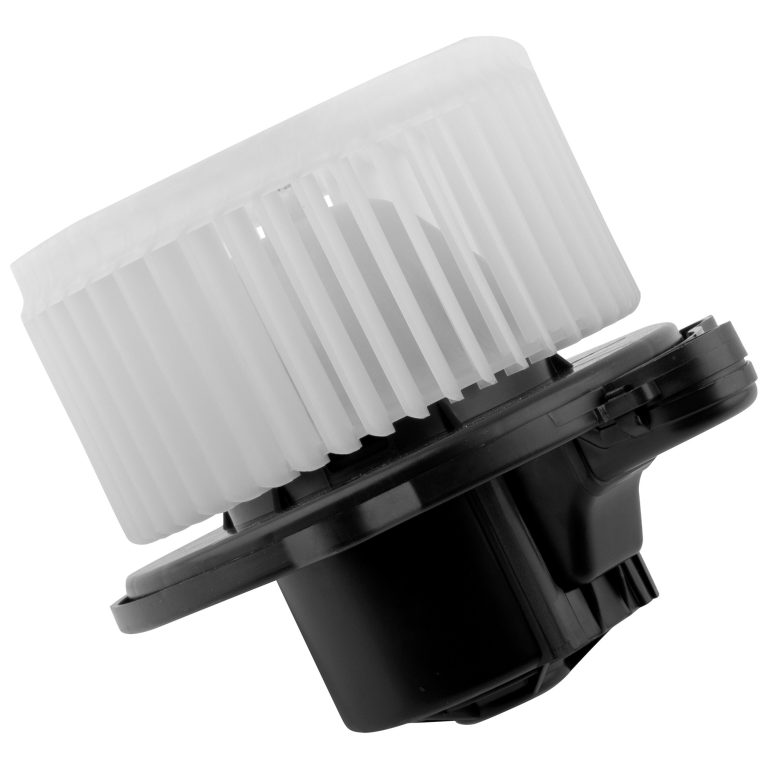
Bad bearings give you more of a squeal or chirp. Especially noticeable at lower speeds when there’s not enough wind noise to cover it up. If you spin the fan by hand and it feels gritty or you can wiggle the shaft side to side, the bearings are toast. No amount of WD-40 is fixing that — you need a Blower Motor. Figure $40 to $90 for the part if you’re doing it yourself, closer to $200 to $350 if you’re paying a shop.
Quick and Dirty Diagnostic
No need to overcomplicate this. Here’s what I’d check, in order:
1. Cycle through the fan speeds. Turn the key on, run the fan from 1 up to high. If speeds 1 through 3 are dead and high works, it’s the resistor.
2. Check the cabin filter. Drop the glovebox down — most of them have little tabs on the sides you squeeze inward. Pull the filter. If it looks like a rectangle of dirt, replace it. A clogged filter is why your resistor burned out in the first place, and if you skip this step you’ll burn out the new one too.
3. Pull the blower motor. It’s under the passenger dash. Usually three or four screws — 5.5mm, 7mm, or a T20 Torx depending on what you drive. Unplug the connector, drop the motor, and look inside the squirrel cage fan. Clean out whatever doesn’t belong. Spin the fan by hand — should be smooth and silent.
4. Look at the resistor connector. When you unplug the resistor pack, check the plastic connector closely. If it’s melted or the terminals are green and crusty, the connector overheated and you’ll need to splice in a new pigtail. This happens a lot on Jeeps especially. Don’t just slap a new resistor into a melted connector and call it good — you’ll be doing the job again in six months.
5. If it’s dead silent — no air at any speed — and you hear a faint click behind the glovebox when you change fan speeds, your blower motor is probably seized or the windings burned up. Replace the motor.
What I See on Specific Vehicles
Jeep Grand Cherokee, especially the WJ (1999–2004) and WK (2005–2010): These melt blower motor resistor connectors like it’s their job. If your fan’s acting up, pull that connector first. I’d say three out of five Jeeps I see with this complaint have charred pins in the harness.
Chevy Silverado and GMC Sierra (2003–2013): Water leaks past the cowl and drips right onto the blower motor. If you live somewhere it rains, expect corrosion. A sealed aftermarket blower motor kit usually solves it permanently.
Ford F-150 (2009–2014): High-pitched chirp at low fan speeds, goes away or gets drowned out on high. Classic dry bearing. Tried lubricating one once — lasted about three weeks. Just replace the motor.
None of this is hard. Most of these jobs you can knock out in half an hour with basic hand tools. The trick is figuring out which part actually failed instead of firing the parts cannon at it. Test the speeds, look at the connector, and pull the motor before you order anything. That’s the difference between fixing it once and fixing it twice.